What Is Money, Anyway?
We use money every single day, yet almost nobody stops to ask the most basic question of all: what actually is it?
In The Money Machine and The Invisible Bill, we watched money get typed into existence on a keyboard — and saw the bill quietly arrive in everyone's mailbox as inflation. But dig one layer deeper — why would anyone accept a piece of paper? And where does the money the government spends actually come from? — and you run into an idea that's very different from what most of us were taught growing up: Modern Monetary Theory, or MMT.
First, to be clear: MMT isn't a government agency, and it isn't some shadowy group pulling the strings on currency. It's a set of ideas that a handful of economists pieced together over a long stretch of time. Its roots go back to the early twentieth century and the German economist Georg Friedrich Knapp, who argued that money's value comes from the state, not from gold. In the 1990s, Warren Mosler, L. Randall Wray and others shaped it into a framework, and later Stephanie Kelton brought it in front of a much wider audience.
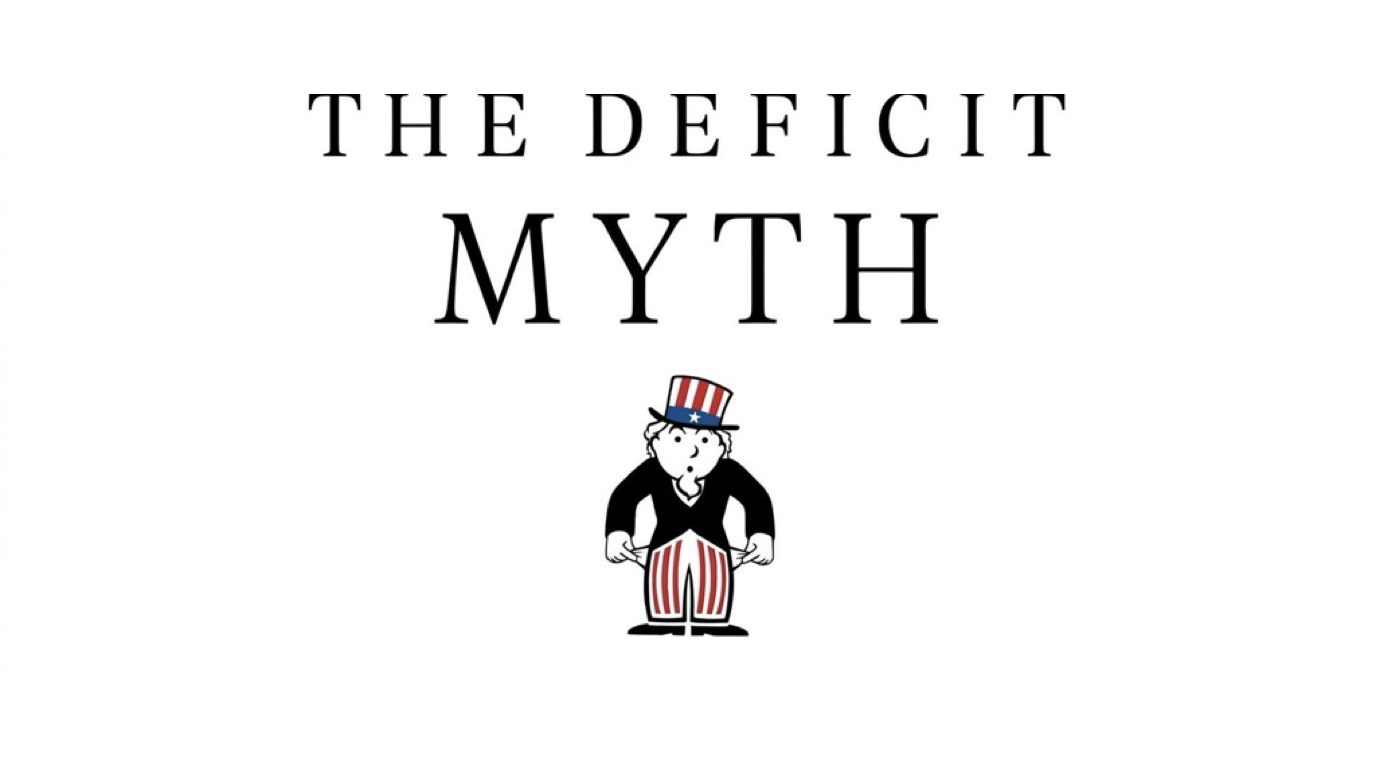
The idea didn't stay locked in academia. In 2015 Kelton served as chief economist for the Democratic staff of the U.S. Senate Budget Committee, and she was a senior economic adviser to Bernie Sanders on both his 2016 and 2020 presidential runs. Her 2020 book, The Deficit Myth, made the New York Times bestseller list.
Still, someone walking into Congress doesn't mean Congress follows along — MMT has never been official U.S. government policy. It's worth your time not because it's necessarily right, but because it forces you to take apart something you use every day and have probably never really thought about: money.
Why Would Anyone Accept a Piece of Paper?
Forget deficits and Treasuries for a moment. Start with the bill in your pocket.
Imagine a brand-new government takes over one day and launches a brand-new currency — call it the A-coin. The government announces: from today, this is the nation's money. The obvious problem hits right away — why would anyone take it? If an A-coin can't buy anything, the government can print as many as it likes and all it has is a stack of paper.
MMT's answer is blunt: make people need it. The government only has to set one rule — taxes are payable in A-coins, and nothing else. Now everyone has to get their hands on some: work for A-coins, sell things for A-coins. Before long, A-coins are circulating through the market. MMT has a well-known phrase for exactly this: taxes drive money.
Of course, that doesn't mean every currency in history was invented so governments could collect taxes; the story of money also involves trade, credit and banks, and it's a lot messier. But the thought experiment raises a question worth sitting with: do you accept a banknote because the paper itself is valuable — or because everyone around you needs it?
Does a Government Have to Have Money Before It Can Spend?
Most people picture a government working like a household: collect taxes first, then, with money in its pocket, build bridges, pay salaries and run public services.
That makes sense, because it's how we all live: without income you can't keep spending, and if you come up short, you borrow. So naturally we assume the government works the same way.
This is the first thing MMT challenges: is a government that issues its own currency really like a household?
Your household can't print dollars. The U.S. government can. So in MMT's eyes, the order actually runs the other way: the government spends first, and that's how dollars flow out to everyone else; taxes pull some of those dollars back. In other words, the government doesn't need to take dollars out of your pocket before it can spend — the moment it spends, that's when the dollars show up in your pocket.
If It Can Create Money, Why Bother With Taxes?
At this point most people's first reaction is the same: so what are taxes even for?
MMT doesn't say governments don't need taxes. It says taxes do a different job than you'd think. Besides making people need the currency, taxes have another role: pulling excess money back out of circulation so prices don't keep climbing.
Picture a small island with exactly 100 loaves of bread, and $100 in everyone's pockets combined. If the government suddenly hands out another $900, there are still only 100 loaves — nobody gets to eat 900 extra loaves. More money chasing the same few loaves leads to one outcome: pricier bread. Taxing at that point is like scooping water out of a bathtub before it overflows.
So What Does It Mean When the Government Borrows?
We hear it all the time: "The U.S. government is short on cash, so it sells bonds to borrow from the market." That's not exactly wrong — the government really does owe principal and interest.
But MMT looks at it from another angle. Say you have $100 in your account and you swap it for a $100 U.S. Treasury bond. Did you lose any money? No — it just changed form, and the new form pays you interest. It's like moving money from a checking account into a savings account.
Zoom that picture out to the level of countries and it gets more interesting. Japan, China and others hold huge piles of U.S. Treasuries, and headlines often describe that as "lending money to America." But where did those dollars come from? Mostly from selling cars, phones and every kind of product to the United States — the payment they received.
Once the deal is done, they're sitting on a big pile of dollars. Left alone, those dollars earn nothing; swapped into Treasuries, it's like moving them from checking to savings — they collect interest every year, and when they need the money, they sell and get dollars back. Seen this way, foreign holdings of Treasuries are less about countries going out of their way to lend to America, and more about finding an interest-paying place to park the dollars they earned from trade.
So to MMT, issuing Treasuries looks more like moving money from one account to another than a government that's run out of cash going to borrow some. That doesn't make Treasuries fake — for the holder, they're a real asset with real principal and real interest. And when a crowd of holders all want to switch from "savings" back to "checking" at the same time — as when countries were dumping Treasuries in The Invisible Bill — prices and yields can still be thrown into chaos.
The Money in Your Hand Is an IOU
Which brings up something that may stop you for a second: the money in your hand is itself a government liability.
Take out a dollar bill and look closely. It doesn't just say "dollar" — it says "Federal Reserve Note." Open the balance sheet the Fed itself publishes, and both the currency in circulation and the money banks keep at the Fed sit in the "liabilities" column. Your bank deposit works the same way: to you it's savings; to the bank, it's money it owes you.
MMT didn't invent this. It's the most basic bookkeeping of the whole monetary system: every asset you hold is someone else's liability. MMT just says it out loud and takes it one step further — treat the government and the central bank as a single entity, and every dollar the government spends is an IOU slipped into private hands; flip over the dollars and Treasuries the private sector has saved up, and you're looking at the government's "debt."
That's what makes it so disorienting. We're used to picturing the national debt as a boulder strapped to the next generation's back — but from this angle, what the government owes is exactly what everyone else has saved. That doesn't mean debt never matters. Most mainstream economists agree the books are kept this way; where they differ, sharply, is on what it means and whether it gives governments room to spend freely.
If It Can Create Money, Why Not Create Unlimited Amounts?
Every question eventually runs into the same wall: if the government can create its own money, why not create some for a bridge, then a bit more for benefits, and call it a day?
MMT's answer: you can't. Because money isn't the stuff itself.
A government can create more dollars, but it can't create more doctors, engineers, chips, oil, land or factories. Those are the real ceiling. When lots of people are out of work and factories are sitting idle, extra government spending can put them back to work; when everyone is already stretched to capacity, the extra money just makes things more expensive.
So the limit MMT really cares about was never "how much money is left in the government's account." It's this: once the government spends more, does the economy have enough real stuff to absorb all that extra buying power?
Put simply, it's the same point The Invisible Bill made: money can be typed into existence, but bread can't. Whatever the economy can't absorb ends up landing on everyone as inflation.
Money can be typed into existence, but bread can't.
A Banknote Is More Complicated Than It Looks
After all that, look again at the bill on the table. It looks like just a piece of paper, but it's tied to the government, the banks, taxes, Treasuries, jobs and everything for sale in the market.
We tend to treat money as wealth. MMT points to something else: money is more like a token everyone has agreed to honor — and what actually makes life good, in the end, is food, housing, energy, health care, and people's time and work.
That's why MMT shouldn't be reduced to "the government can just keep printing money." What it really challenges are our most intuitive, least questioned assumptions about money.
There's no need to settle these questions here. But once you start taking money apart, it's hard not to turn back and ask yourself: if money isn't wealth itself, but an IOU someone else owes you, then what do we actually own with all the money we work for, save, and invest every day?
This introduction to Modern Monetary Theory (MMT) draws on research published by the Levy Economics Institute of Bard College, Stephanie Kelton's public biography, and the Federal Reserve's published explanation of its balance sheet. It explains how the monetary system works and does not endorse or oppose any economic policy. This article is educational and does not constitute investment advice.