The Question the News Never Answers
Open the news lately and it's the same handful of words on a loop: sell-off, yields, inflation's coming back. The pundits are worked up about it — but nobody seems willing to say the simplest thing out loud: the money sloshing through these markets, where does it actually come from?
There's something even stranger here. Every year the US government spends about two trillion dollars more than it takes in. Which makes it, basically, a guy living on borrowed money. So isn't it odd — a government that can't survive without borrowing somehow has the nerve, and the means, to turn around and lend tens of billions to somebody else?
The answer's simpler than it sounds: it starts at a keyboard and ends at the price of the food on your table. It's a machine, humming away quietly. And the trouble with a machine like this is that once you see how it turns, you can't ever un-see it.
Let's start with a gambler.
Someone Ran This Exact Trick 300 Years Ago
France, 1716. Fresh out of a war, the treasury empty, the government all but broke. In walks a Scotsman named John Law. No ordinary man — in his youth he killed someone in a duel, caught a death sentence, broke out of jail, and rebuilt a fortune across Europe on a gift for math and a cold eye at the gambling table. He came to Paris with a bold pitch: France is short on gold? Then stop using gold — use paper.
And he actually sold the government on it: open a bank, print notes, get everyone to believe the paper's as good as gold. At first it worked like magic. Money multiplied overnight, business boomed, shares shot up, and Paris minted new-money fortunes by the crowd — the word "millionaire" was coined right there and then, for exactly these paper-rich upstarts.
Then a few people got a bad feeling and went to swap their paper back for real gold. One, then two, then the whole city stampeding to convert at once. In 1720 the bubble popped. Turned out there was nowhere near enough gold behind the paper — and the paper turned back, overnight, into a stack of worthless paper.
Here's the deadly little secret at the heart of all of it — hold onto it, we circle back at the end: money conjured out of thin air works just fine as long as nobody shows up demanding to swap it for something real. But the moment enough people do, the illusion breaks. What we run today is, underneath, Law's trick with an upgrade — it's just buried the question of "is there really enough gold?" deeper, and far more cleverly.
When You and I Come Up Short, It's Called Broke. When the Government Does, It's Called a Bond
Cut back to today. The government has to spend too — armies, salaries, interest on old debt, all of it burning cash — and the taxes it takes in always fall short. So what does it do about the gap? It borrows.
Same as you and me: short on cash, write an IOU — except its IOU has a respectable name, a government bond. In black and white: you lend me a sum now, I'll pay back the principal on a set date, and slip you a little interest each year along the way. It's the biggest IOU-writer on earth, and the hole it fills each year is roughly that two trillion. That part's not strange. What's strange is the next move — how it guarantees these IOUs always find a buyer.
An Auction That Can Never Fail
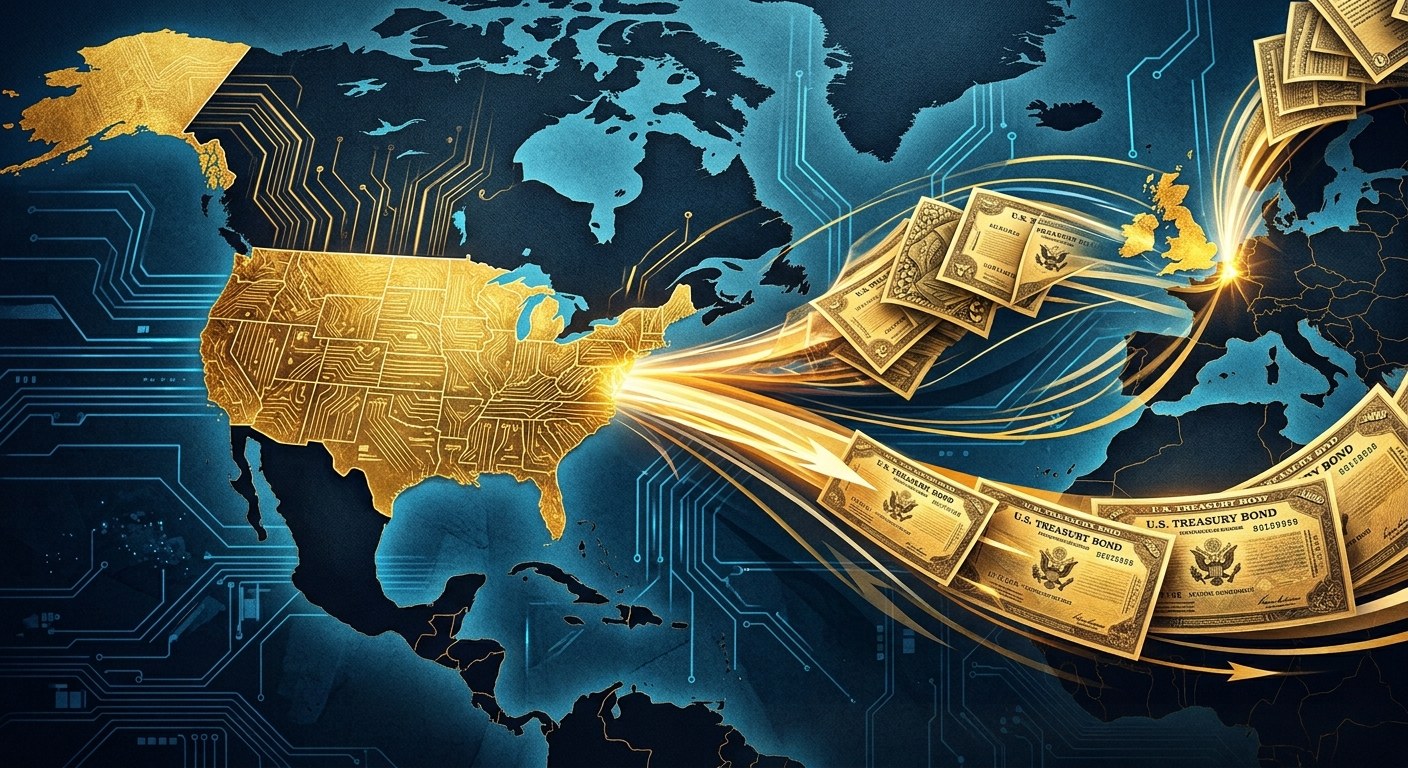
The government sells its bonds by auction. In theory that's risky: what if nobody's in the mood that day, nobody raises a paddle? It thought of that. Two dozen or so of the biggest financial institutions — the JPMorgans and Goldmans of the world — get anointed "primary dealers." Take the role, and you accept one hard rule: every single bond auction, you show up, and you buy. So even on a day when real demand is dead quiet, these two-dozen "first buyers" swallow the debt. That's why you'll never see a headline that reads "US bond auction fails" — not because everyone's clamoring for it, but because the rules simply won't let it fail.
Once they've swallowed it, they turn around and sell it on: Japan, pension funds, insurers, retail folks like you and me. The bond flows into the market and starts changing hands — and the instant its price can move up and down, something nasty appears.
There's a Number That Gets Bigger When It Falls
Go slow here. Get this, and everything after just clicks.
You buy a bond for a thousand bucks. It pays you a fixed fifty a year. Your return: fifty over a thousand — five percent.
Now the part that matters. That bond can be resold, and its price moves. Say people start dumping this kind of bond and the price drops to eight hundred — but the "fifty a year" doesn't budge. So whoever picks it up at eight hundred gets fifty over eight hundred: six and a quarter percent.
See the trick? The price falls, and the return climbs. The two always move in opposite directions. That return has a name — the yield. It's the single most important number on the planet, because almost everything anyone anywhere pays to borrow takes its cue from it.
Now the news makes sense. "Countries dumping US bonds" just means a flood of bonds hitting the market, price stomped down — and as the price drops, the yield gets shoved up. That "yields spiking" line you keep reading? It's this up-one-down-the-other ghost at work. Which is exactly why the yield earns the name "the price of money" — it's what the world has to pay to borrow.
The Fed Isn't as All-Powerful as You Think
Time to puncture a belief nearly everyone holds: that interest rates are set by the Fed. They're not. The one rate the Fed squeezes directly is the ultra-short benchmark banks use to lend each other cash overnight. Picture it as "the overnight wholesale price." But the rates you actually care about — your mortgage, your car loan, the government's thirty-year borrowing cost — don't follow that overnight price. They follow the longer-term yields the market hammers out on its own.
Which is why you'll sometimes see something that looks upside down: the Fed "cuts rates," and your mortgage rate goes up, not down. The Fed cut its overnight price — but the long yields are the market's call, and if the market's busy dumping long bonds (price down, yield up), your mortgage can climb right along, no matter what the Fed did that day. It's not the weather-god you think it is.
When Nobody Will Buy, Somebody Types It In
Here's the jam. Suppose one day the market genuinely loses its appetite for government bonds — even the primary dealers can't offload what they swallowed — and yields threaten to rip out of control. For the government that's the sky falling, because its borrowing costs blow up with them. So then what?
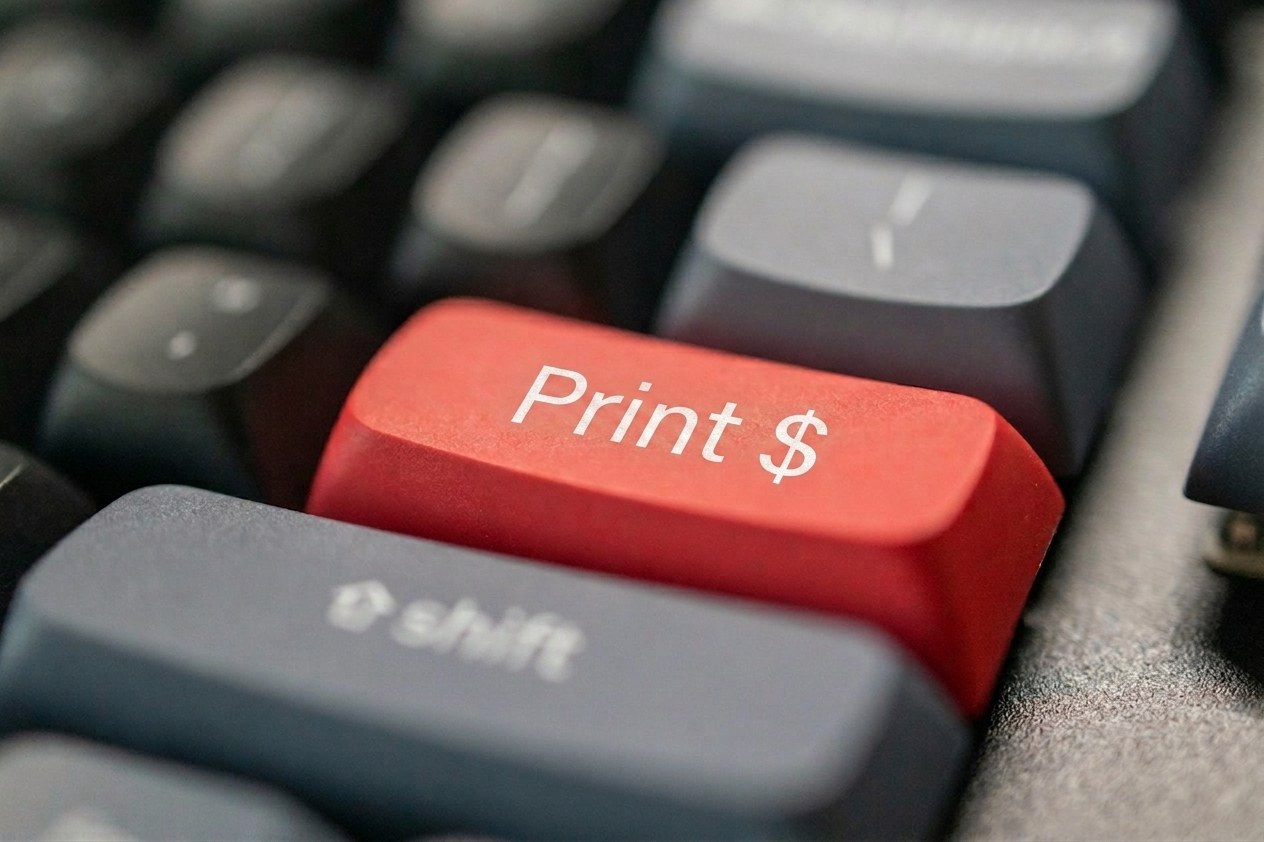
Then a "buyer of last resort" walks on: the Fed itself. It steps in, buys the unwanted bonds by the fistful, props the price, forces the yield back down. Buys with what? This is the most crucial, most skin-crawling step in the whole machine: it pays with money conjured on the spot — money that didn't exist one second before the keys went down. It doesn't raise the funds first; a few keystrokes, and the money's in the other account. So the whole line runs: government issues debt to borrow; primary dealers, the "first buyers," guarantee the auction clears; and the Fed, the "last buyer," with a checkbook that has no bottom, because its money comes from nowhere. That move — the Fed printing money by the truckload to buy bonds — is the phrase you keep hearing and rarely get explained: quantitative easing. QE.
And there it is: the first big riddle already has its answer. A big chunk of that money was typed into being.
A big chunk of that money was typed into being.
So What's This Got to Do With You?
If money can just be typed into existence like that, one thing's suddenly clear: that wad of cash in your hand is standing on the side that gets watered down. Every turn of this machine, the note in your wallet buys a hair less. Not saying this to scare you — saying it to point somewhere: faced with a dilution you can't stop, the dumbest move is to park a big pile of money, untouched, and watch it shrink. What to actually do about it, we'll get into next time.
Because we've only cracked half the riddle. Money can be conjured from nothing — which raises the bigger second question: how can a government that lives on borrowed money afford to lend to anyone else? And all that conjured money — who ends up carrying the bill? In the next piece, "The Invisible Bill," we take apart the back half of the machine, and show you how an ordinary person steps over to the other side of the dilution.
Parts of this piece's narrative and framing are drawn from a public video by The Jay Martin Show, together with public financial data and the historical record of John Law and the Mississippi Bubble. This article is educational and does not constitute investment advice.