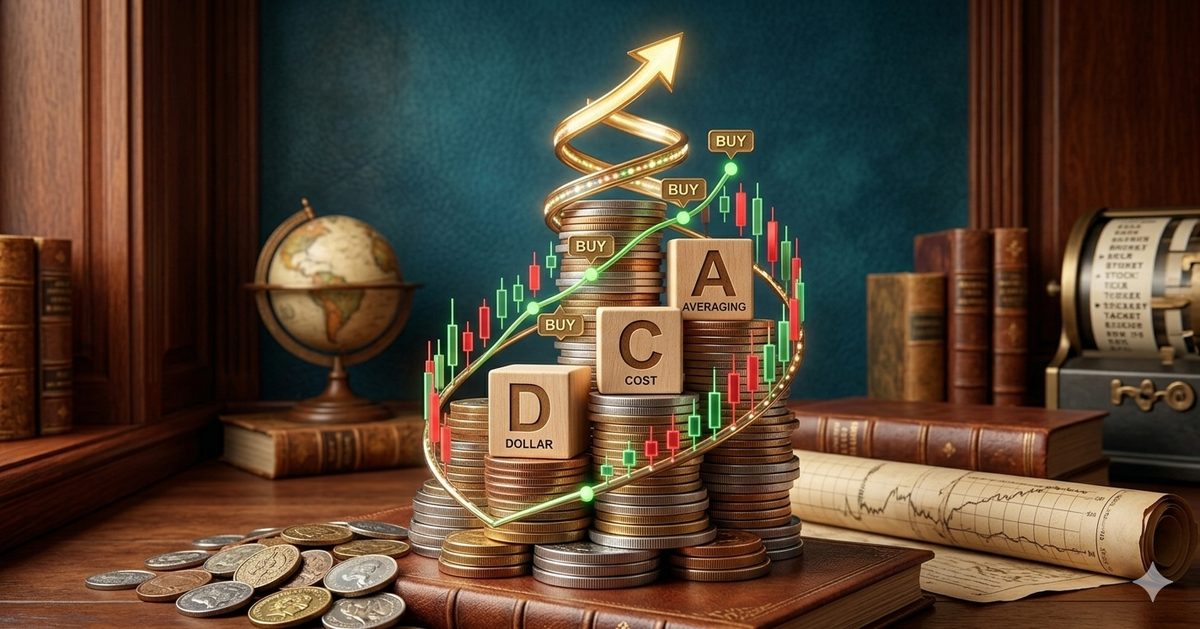
Almost every investor eventually faces the same question: should I invest steadily over time, or wait for the perfect moment when the market drops? It's the classic standoff — dollar-cost averaging versus buying the dip.
Both sound reasonable. One says: invest a fixed amount on a regular schedule, no matter what the market is doing. The other says: keep your cash ready and pounce when prices fall. On paper, buying the dip even sounds smarter — who doesn't love buying at a discount?
But there's a catch hiding inside that logic, and 20 years of data exposes it clearly.
The Problem With Waiting
Buying the dip assumes you can recognize a temporary decline and act on it. But when exactly is a dip? Is it a 5% drop? 10%? What if prices fall, you wait for more, and the market rebounds without you? What if you buy early and it keeps falling, leaving you with no cash left to average down?
Even professional investors struggle to time the market. And history shows markets tend to rise over time — so waiting for the perfect entry often means missing the ride entirely.
The Schwab Study: Five Investors, 20 Years
Charles Schwab ran a now-famous analysis tracking five hypothetical investors over 20 years (2003–2022). Each received $2,000 every year to invest in the S&P 500 — but each used a different strategy.
Peter Perfect had a superpower: he timed the market flawlessly, investing his $2,000 at the exact yearly low every single time. After 20 years, he had over $138,000 — the best result, as expected.
Ashley Action didn't overthink it. She invested her $2,000 on the first trading day of each year. Her result: over $127,000 — just about $10,500 behind the perfect market-timer, despite never timing a single dip.
Matthew Monthly used dollar-cost averaging, splitting his $2,000 into 12 equal monthly contributions. He finished with over $124,000 — remarkably close to Ashley, proving the power of staying consistent.
Rosie Rotten had the worst timing imaginable, always investing at the market's yearly peak. Even then, she ended with $121,000 — far better than you'd expect, simply because she stayed invested.
The procrastinator who waited for the perfect moment finished with just $44,000 — less than a third of everyone who simply invested.
Larry Linger was the procrastinator. He kept his money in cash, waiting endlessly for the ideal entry point that never felt right. He finished with about $44,000 — by far the worst outcome.
Read that ranking again. Even Rosie, who invested at the worst possible moment every year, nearly tripled the result of Larry, who waited for perfect timing. The lesson is brutal and clear: time in the market beats timing the market.
Why We Still Get It Wrong
If the data is this obvious, why do so many people still try to time the dip? Because the strategy fights human psychology. It's easy to say "I'll buy when the market drops." But when the drop actually comes, fear replaces logic. Instead of buying, people freeze — or worse, they sell.
Even Warren Buffett has long argued that for the vast majority of people, the smartest approach is to consistently invest in a low-cost index fund rather than trying to outsmart the market. Your mindset, in other words, matters as much as your strategy.
The Best of Both Worlds
Here's the nuance most people miss: this isn't actually black and white. Following a dollar-cost averaging plan doesn't forbid you from ever taking advantage of a dip.
In fact, many disciplined long-term investors do both — they stick to a steady DCA schedule for consistency, and keep a modest amount of cash on hand to deploy when the market drops meaningfully. The base plan keeps them invested through everything; the reserve lets them lean in when prices genuinely fall.
The key is the order of operations: consistency first, opportunism second. You never stop investing while waiting for a dip — you invest steadily, and treat the dips as a bonus, not the whole plan. That single shift is the difference between Rosie's $121,000 and Larry's $44,000.
Data from Charles Schwab's "Does Market Timing Work?" study (2003–2022). Educational content inspired by publicly available analysis; not investment advice.